An experience is anything guests book that is not a plain table: a supper club or a Mother's Day lunch, a pasta-making class, a celebration cake consultation, a kitchen garden tour. Once an experience is created and published, guests can book it from your restaurant listing. This article walks through setting one up.
Where experiences live
Sign in to manage.makearezzy.com, pick your business, and open Experiences from the left-hand menu. The list shows every experience you have set up, published or not, with its type, how guests pay and its starting price. Once you use categories, the list is grouped by them. Click any experience to see its summary; click Add experience to start a new one.
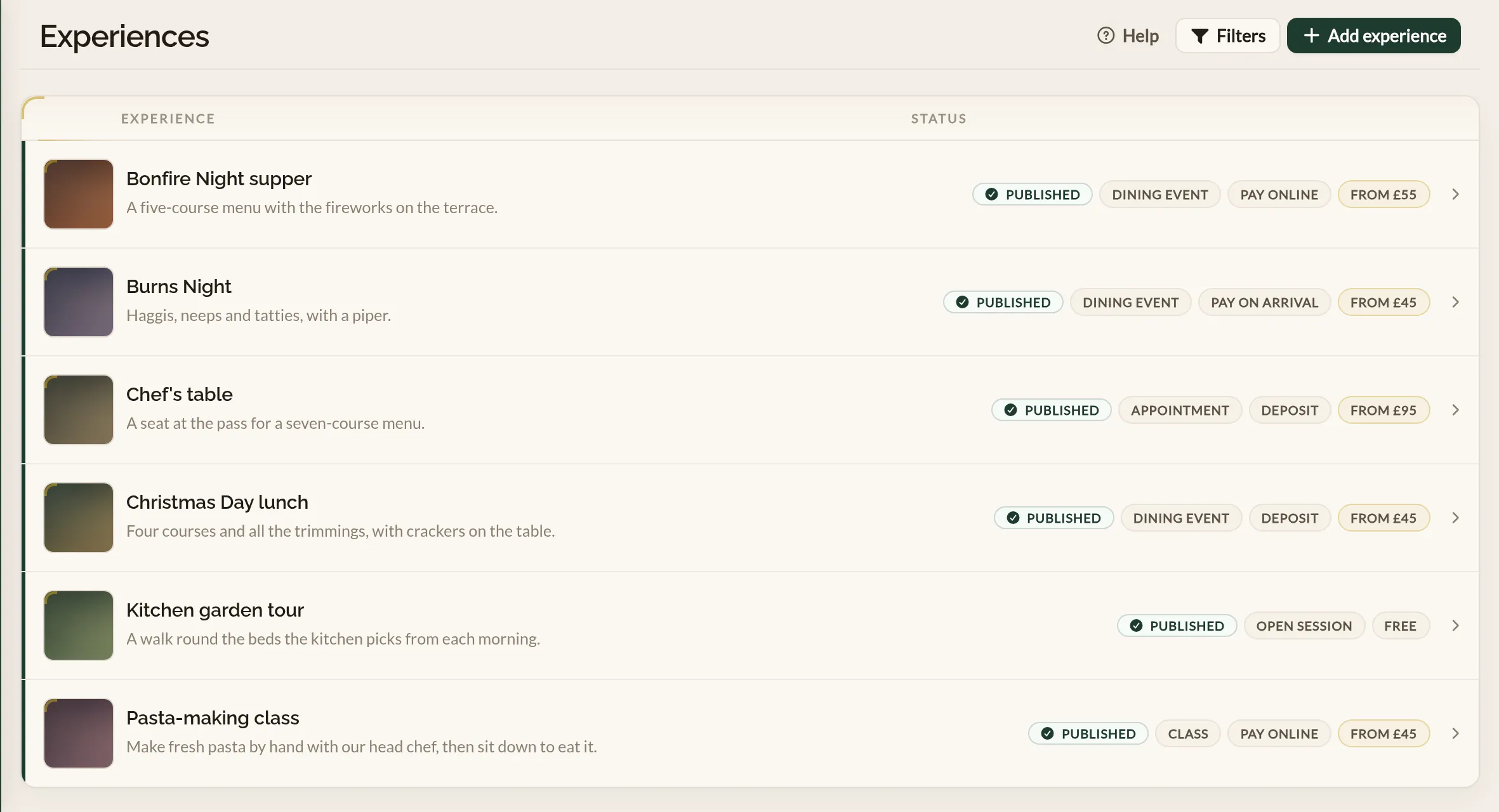
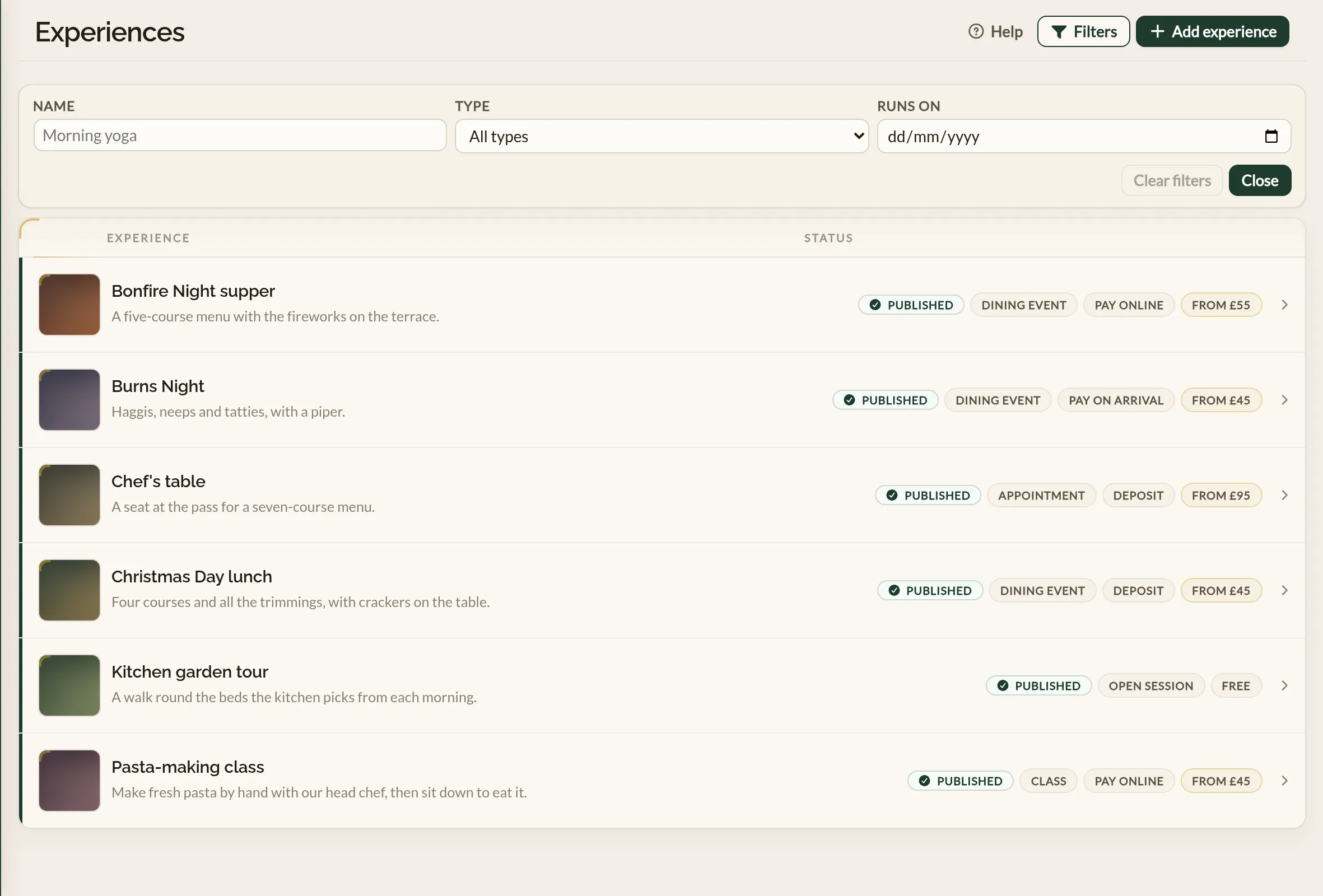
Filters narrows the list by Name, by Type, or to the experiences that have a bookable time on a given day with Runs on. Times are only worked out as far ahead as the Days visible to customers setting in Business details, so a day beyond that shows nothing yet.
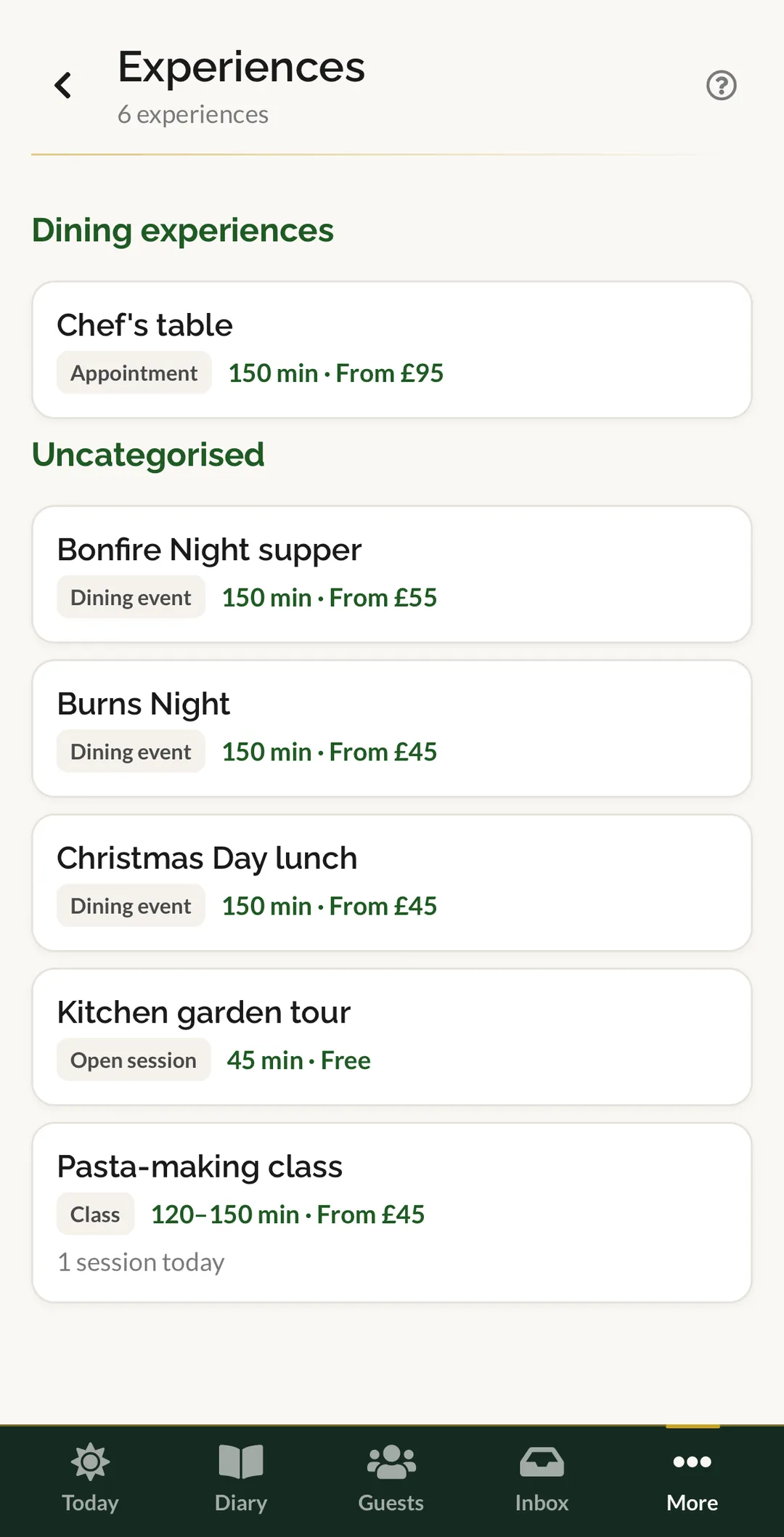
In the app, open More and tap Experiences. The list is grouped by category, and each experience shows its type, how long it runs, its "from" price and, for a class, how many sessions run today. An experience that is not yet published carries an Unpublished chip. Tap one to see its summary and its bookings for the day.
Experiences are created and edited on the web. On an experience's page in the app, Edit on web opens the same experience on the manager site.
What are you setting up?
Click Add experience and pick the closest match from four types. The type decides which parts of the form you see.
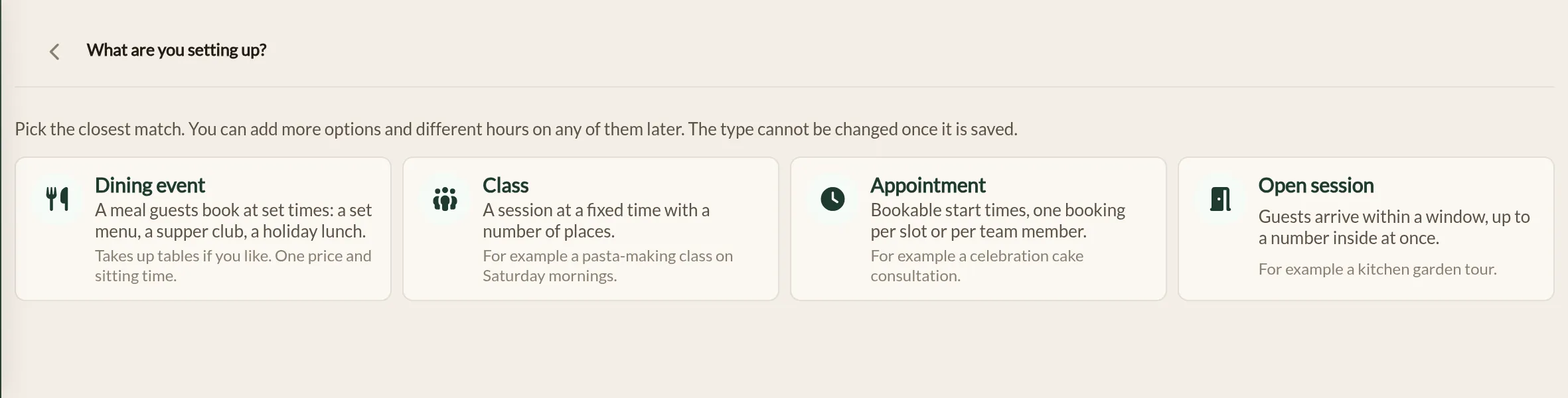
- Dining event — a meal guests book at set times: a set menu, a supper club, a holiday lunch. It can take up tables, and it starts with one price and one sitting time, and you can add more options.
- Class — a session at a fixed time with a number of places, such as a pasta-making class on Saturday mornings.
- Appointment — bookable start times, one booking per slot or per team member, such as a celebration cake consultation.
- Open session — guests arrive within a window, up to a number inside at once, such as a kitchen garden tour.
The experience form
The form is one page. You fill in the sections in any order and click the create button at the bottom, which names the type — Create dining event, Create class and so on. A dining event shows a shorter form:
- Dining event — Event details, Price and sitting time, Tables and places, Payment, When.
- Class, appointment or open session — Details, Pricing & Duration, Payment, Schedule, and Tables if you also take table bookings.
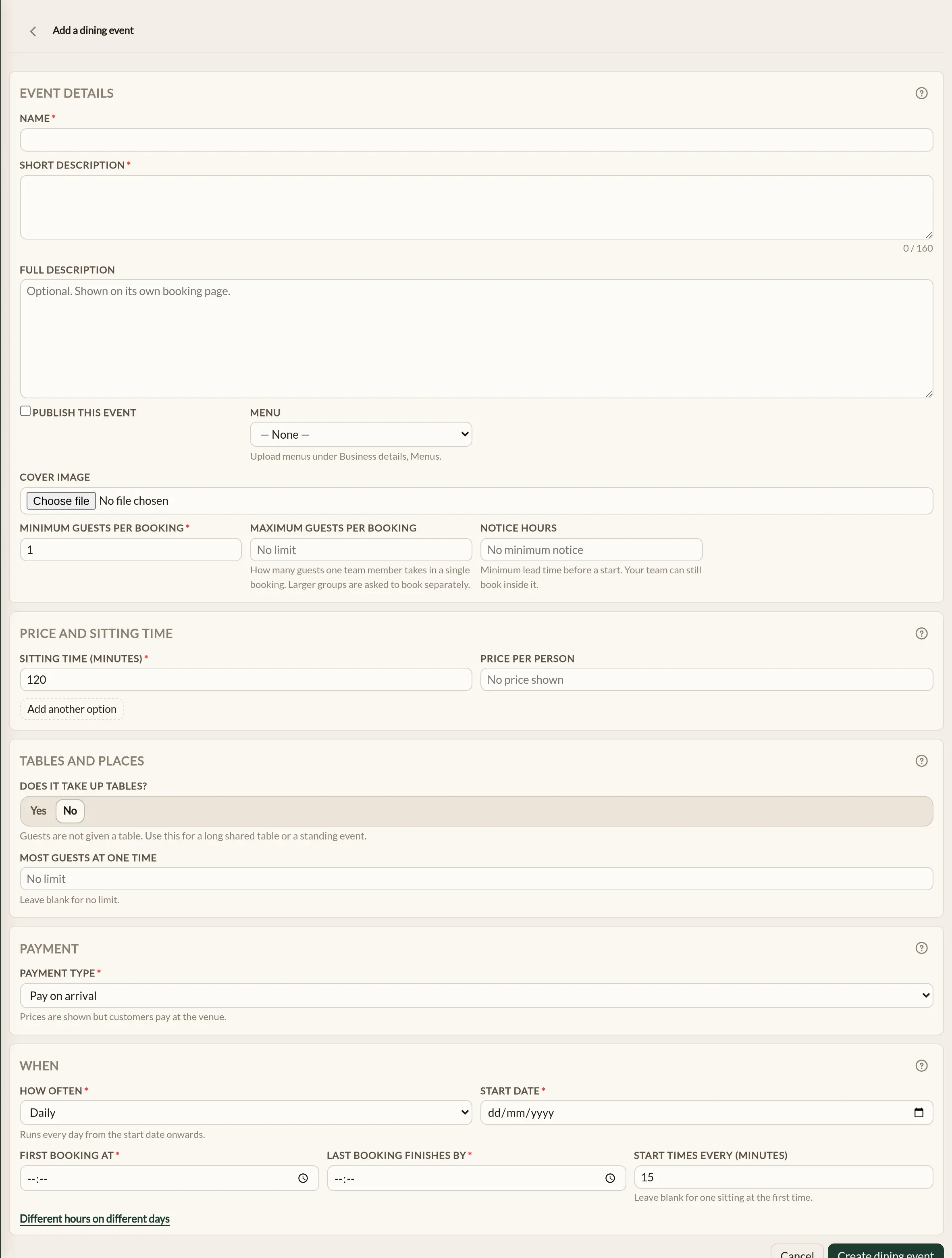
Details
A dining event calls this section Event details.
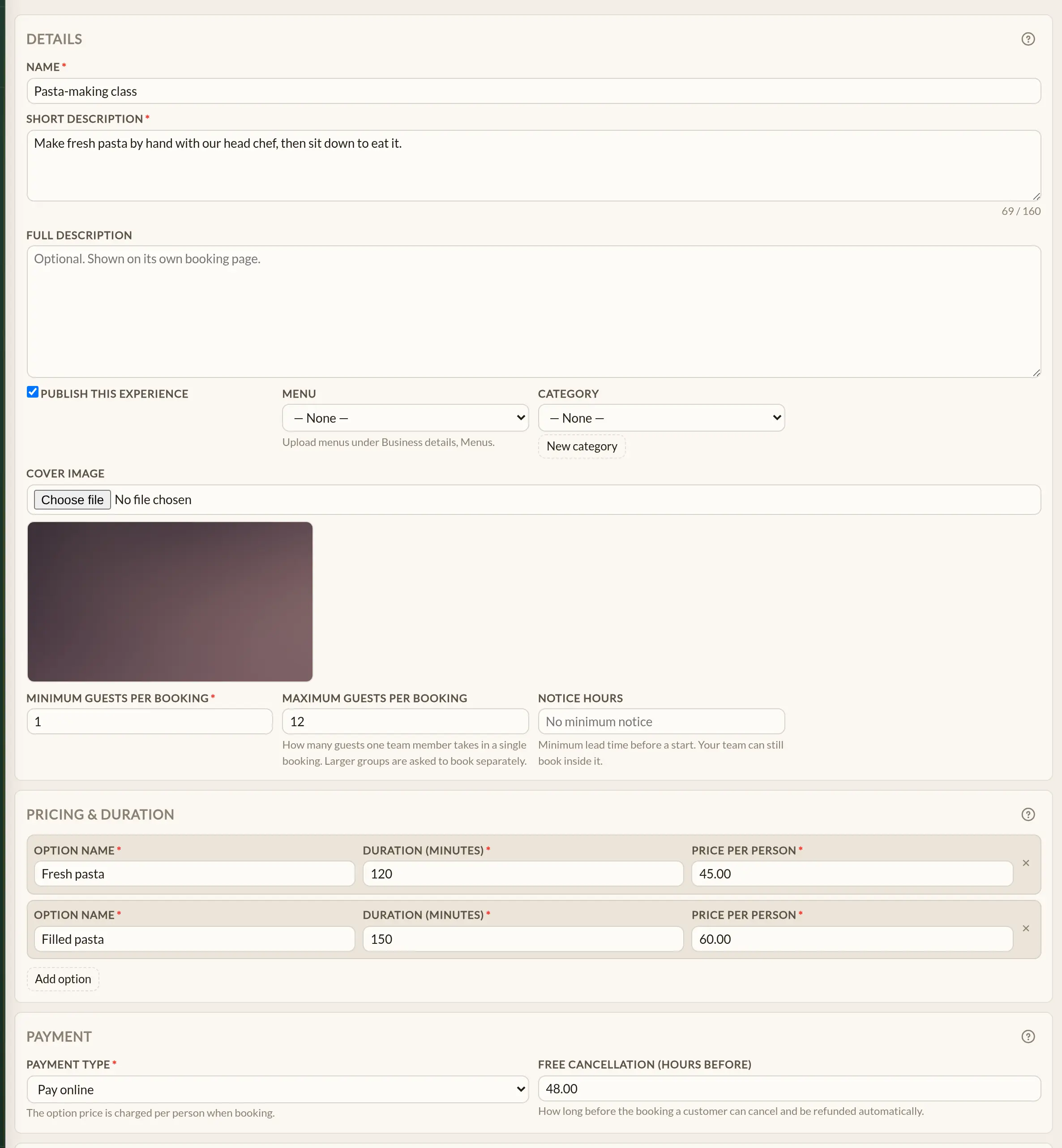
- Name — what the experience is called. Must be unique within your business.
- Short description — the line guests see on your experiences page, and the summary search engines show.
- Full description — optional, and as long as you like. It replaces the short description on the experience's own booking page, so use it to explain what is involved, what is included and anything guests should know before they arrive. Leave it blank and the short description is shown there instead.
- Publish this experience (Publish this event on a dining event) — leave this unticked while you are still drafting. Nothing is shown to guests until it is published.
- Menu — an optional menu guests can view before they book. Upload menus under Business details, then pick one here. See Linking a menu to an experience.
- Category — an optional group heading for your experiences page, such as "Classes" or "Tours". Pick one from the list, or click New category to create one on the spot. Dining events do not have a category. See Categories below.
- Cover image — an optional photo shown alongside the experience.
- Minimum guests per booking and Maximum guests per booking — the smallest and largest party one booking can be. For an appointment this is how many guests one team member takes at once: a consultation might be 1 to 4. Leave the maximum blank for no limit. A larger party is asked to book separately rather than being squeezed into one booking.
- Notice hours — the minimum lead time before a guest can book. Leave blank to allow last-minute bookings. Your team can still book a guest in inside the notice period.
Price and length
Every experience has at least one bookable option, with a length and a price per person. A dining event calls this Price and sitting time: fill in Sitting time (minutes), how long guests stay, and Price per person. The other types call it Pricing & Duration, with Duration (minutes) in place of the sitting time.
If the experience comes in more than one version — a children's menu at a lower price, or a 60 and a 90-minute class — click Add another option. Each option gets its own name, length and price, and guests pick one when they book. Your experiences page shows the cheapest option as the "from" price.
Tables
If your business takes table bookings, you choose whether each booking is given a table from your floor plan. A dining event asks Does it take up tables?, under Tables and places, and starts on Yes. The other types have a Takes up tables tick box, under Tables, which starts unticked.
An experience that takes up tables is only offered while your restaurant is open, and its bookings count towards your covers like any table booking. A dining event that does not take up tables can set the Most guests at one time instead, or leave it blank for no limit. See Tables, experiences or both.
Payment
Pick how guests pay: Free, Pay on arrival, Pay online or Deposit. For Pay online and Deposit you can also set how many hours before the booking a guest can cancel and be refunded. See Pricing, payment and cancellation.
When it runs
A dining event has a short When section. Pick How often it runs:
- Daily — every day from a start date, with no end date.
- Weekly — on the days of the week you pick, from a start date, with an optional end date.
- One-off — on a single date.
- Multiple dates — on the dates you add to a list.
- Date range — every day between a start and an end date.
Then set First booking at and Last booking finishes by. The finish time is when the last guests leave: with a two-hour sitting and a 22:00 finish, the last booking starts at 20:00. Start times every (minutes) sets how often a booking can start; leave it blank for one sitting at the first time. A dining event that runs every Friday in April from 18:00 to 22:00 is one experience, not four. If it runs different hours on different days, click Different hours on different days to open the full schedule editor.
A class, appointment or open session has a Schedule section instead: how often it runs, its time windows and how many can book each one. Leave the number blank for no limit. This has its own article — Schedules and capacity.
In the Schedule section, tick the people who deliver the experience under Team members who deliver this. Only assigned team members can be given its bookings or run its sessions, and only they count when it needs a free team member. The same link can be set from the other side, on the Team page. If nobody is assigned, the form says so: an appointment or open session that needs a free team member will show no availability online, and an appointment that follows the schedule will take bookings but leave them unassigned for you to allocate.
Appointments also carry Customers choose their team member. Switch it on and guests booking online pick who they would like — or "No preference" — before choosing a time, and the calendar narrows to that person's free times. Only team members assigned to the experience and marked bookable online are offered. With the setting off (the default) no picker is shown; either way, bookings that arrive without a chosen person are assigned to an available team member automatically, or left unassigned when nobody is free.
Categories
Categories are the group headings on your experiences page — the way a list of things to book might split into "Classes", "Tours" and "Private dining". They are entirely yours to define. Experiences without a category are grouped under "More" at the end of the list, so if you use categories, it is worth giving every experience one.
Publishing and unpublishing
Ticking Publish this experience and saving is all it takes for guests to see it. Whether a guest can book it depends on the date, time and party size they pick: it has to be running then, outside its notice hours, within its party-size limits, and not already full. On your Explore page, an experience that cannot be booked for the guest's choice still appears, with a short note saying why and, where there is one, a link to the next time they could book. Your website widget shows the same note, or can hide those experiences — see Customising the widget.
The summary page shows whether an experience is currently Published or Unpublished; to change it, edit the experience and save. Unpublishing hides it from new bookings straight away but does not cancel any existing bookings.
What the guest sees
Published experiences appear on your experiences page, grouped by category with their "from" price and length. Guests reach it from the Book an Experience button on your Make a Rezzy listing, which appears once at least one experience is published. Your website widget can list them too — see Customising the widget. Booking takes a few steps:
- They pick an experience, and an option if it has more than one.
- If the experience lets customers choose their team member, they pick a person — or "No preference" — first.
- They pick a date from the calendar (only days with availability can be selected), and then an available time.
- They fill in their name and contact details. If the experience takes payment, they are passed to a payment form before the booking is confirmed — the same payment flow as any other Make a Rezzy booking.
The booking lands in your diary like any other, marked with the experience and option it is for.
The day's bookings and class rosters
Bookings for an experience that takes up tables sit in the Calendar's tables view like any table booking. Bookings for other experiences appear on the Calendar's Experiences view, by team member and class — see Calendar overview.
To book a guest in yourself, click Book a guest in at the top of the experience's page. Taking a booking by phone walks through the form.
An experience's page in the app opens on today, with arrows to step to another day. For a class it lists the day's sessions, each with who runs it and how many places are taken — "3 of 12 booked", or Full in coral once the spots are gone. Tap a session to open its roster: the guests booked onto it, with their party size, dietary needs and notes. For any other experience it lists the day's bookings in arrival order.
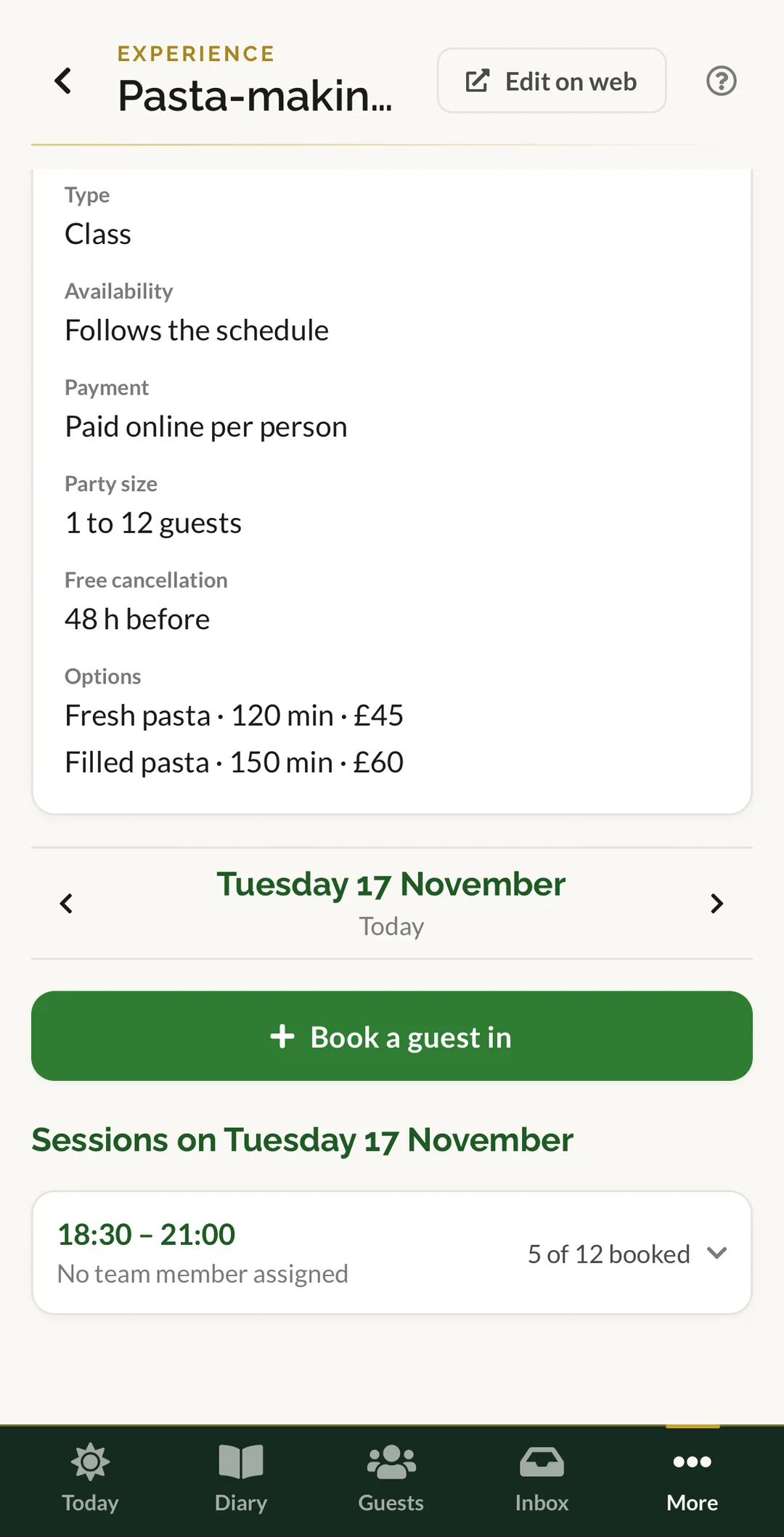
Tap a guest to open their booking. Marking them Seated is how you check a guest in — there is no separate check-in step, and the count on a class session updates as you go. See How bookings work for the rest of the booking sheet.
To book a guest in yourself, tap Book a guest in under the day, or open a class session's roster and tap Add guest to book them straight onto that session — the time is already chosen, and a full session can still be booked after a quick confirmation. Taking a booking by phone walks through the rest of the form.
Editing and removing an experience
Open the experience from the Experiences list and use Edit to change anything on it except its type. Changes take effect straight away, and the available times are reworked automatically after a schedule change.
To remove an experience entirely, use Delete from its page. Deleting does not cancel its existing bookings — handle those first.
Experiences cannot be edited or deleted in the app. Open the experience and tap Edit on web to change it on the manager site; changes take effect straight away and the app picks them up the next time you open the experience.
Where to go next
- Schedules and capacity — the Schedule section in detail.
- Pricing, payment and cancellation — choosing how guests pay, with worked examples.
- Tables, experiences or both — how experiences sit beside your table bookings.
- How bookings work — once an experience is published, its bookings flow through the same statuses as every other booking.
See also: Restaurant events and ticketing